From a common
Norman personal name, Ingram,
of Germanic origin, composed of the elements Ing
(the name of a Germanic god) + hraban
‘raven’.
c) Ingram:
Other versions of the name includeIngelram,
Ingeram,
Ingraham, Ingrome, Ingrum.
d) Ingram: In
Scotland, Ingram is a sept of the Clan Colquhoun:-
In the 13th
century the
lands of Colquhoun
in Dunbartonshire were granted to Humphry de Kilpatrick. His son,
Ingelram de Colquhoun, was the first person recorded as taking
Colquhoun as a surname.
Early Ingrams:
The
surname INGRAM derives from the old personal name
Ingelram. Early records mention Hyngelrom ( without surname ) who
witnessed a charter by King David I to the Abbey of Neubottle in 1142.
John Ingeram held lands of
the Abbott of Arbroath in 1330.
Sir William Ingelram was the
chaplain of Stirling, Scotland in 1476.
Herbert Ingram ( 1811-60 )
the English journalist was born in Boston, Lincolnshire. In 1842 he
founded the '' Illustrated London News ''. He was
MP for Boston from 1856.
Collingwood Ingram, known as
Cherry Ingram ( 1880-1981 ) the English ornithologist, botanist,
gardener and traveller was the grandson of the newspaper
proprietor, Herbert Ingram. He had a garden at Bettenden, Kent that was
celebrated for his collection of Japanese ornamental cherries. His
books include '' The Birds of the Riviera '' (
1926 ) and '' A Garden of Memories ' ( 1970 ).
Henry
was the first to hold the title Lord Ingram, andViscount
Irvine,
in thePeerage
of Scotland,
( Viscount Irwin in England ).
Henry Ingram's father, Sir Arthur Ingram junior ofTemple
Newsam(
died 1655 ), was son of the notable landowner and Member of
Parliament Sir
Arthur Ingramthe
elder ( 1565-1642 ).
Sir Arthur ( junr.) was the elder half-brother of SirThomas
Ingram(1614-1672)
An
EnglishMember
of Parliamentandpeer.
He was theVice-Admiral
of YorkshireandMember
of ParliamentforYorkshireandScarborough.
He was the father or grandfather of all the later Viscounts Irvine.
The 3rd Viscount Irvine was the younger of two sons of the1st
Viscount, Henry Ingram,
ofTemple
Newsam,
and younger brother of the 2nd Viscount, Edward Ingram ( c1662–1688 ). Edward
inherited the title at the age of 4, on his father's death, and
therefore their mother the Viscountess Essex Ingram, née Montagu (
daughter ofEdward
Montagu, 2nd Earl of Manchester
), was the more important parental example.
Arthur
married Isabella Machell (1670–1764), elder daughter ofJohn
Machell( 1637–1704, M.P. forHorsham,
Sussex ) of Hills Place ( Horsham )and Helena
Warmestry.The
marriage reinforced older Machell connections with the Rich family,
from which Viscountess Essex Ingram, Arthur's mother, was also
descended.
Arthur
inherited the titles and the benefit of his brother's estate in 1688.
His nine sons, heirs to the Viscountcy, were born between 1686
and 1701.In 1691 Isabella's sister Caecilia Maria
married John Parsons atAll
Hallows-on-the-Wall, and they had a daughter Helena.
A British
soldier and politician. Ingram was the seventh of the nine sons ofArthur Ingram, 3rd
Viscount of Irvine - known as Irwin in England, by Isabella
Machel, daughter ofJohn
Machell,Member
of ParliamentforHorsham,
of Hills,Sussex.
He was ageneralin
theBritish
Army.In 1737 he was returned to Parliament
for Horsham ( succeeding his elder brotherHenry).
Ingram married Elizabeth Scarborough, daughter and co-heiress of
Charles Scarborough, Clerk of theBoard
of Green Cloth,
ofWindsor,
Berkshire,
in 1726. They had one son,Charles,
later 9thViscount
of Irvine,
and three daughters
The
Honourable Henry Ingram was an English landowner and
politician. Irvine was the fourth son ofArthur
Ingram, 3rd Viscount of Irvine, by Isabella Machell,
daughter ofJohn
Machell,Member
of ParliamentforHorsham,
of Hills,Sussex.
He was returned to Parliament for Horsham in 1721 ( succeeding his
elder brotherArthur
), a seat he held until 1736.Lord
Ingram married Anne Scarborough, daughter and co-heiress of Charles
Scarborough, ofWindsor,
Berkshire,Clerk
of the Green Cloth.
There were no children from the marriage. He died in April 1761, aged 69and
was succeeded in the viscountcy by his brotherGeorge(
the sixth son )
Edward Machell Ingram, 4th Viscount of Irvine ( 1686–1714 )
Following the crusades in
the 11th, 12th and 13th centuries, a need was felt for a family name to
replace the name given at birth or as an addition to it. This
was recognized by those of noble
birth, particularly those who went on the Crusades,
as it added prestige and practical advantage to their status.
The rise of surnames,
according to accepted theory, was due to the Norman Conquest
of 1066 when Old English personal-names were rapidly superceded by the
new christian names introduced by the Normans. A few of these
were popular and in the 12th century the shortage of different
christian names led to an increasing use of surnames to
distinguish individuals with the same name. Some Normans had
hereditary surnames before coming to England however surnames
would probably have developed in England without the Norman
Conquest as the development of the feudal system made it
essential for the king to know exactly what service
each person owed. Payments to and by the exchequer required that
debtors and creditors should be distinguishable and it
became a
requirement that individuals had
an exact identification.
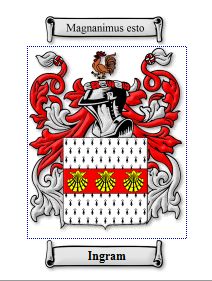
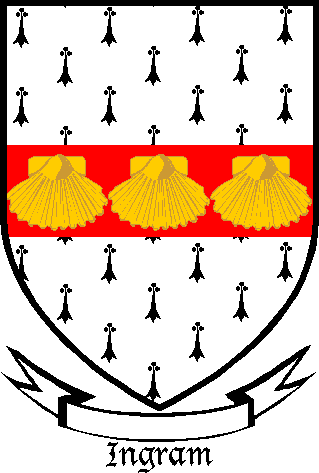
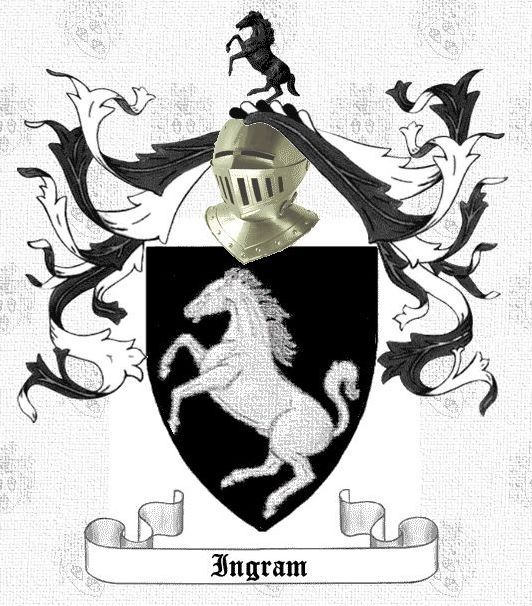
The associated arms for
family names are recorded in Sir Bernard Burkes General Armory. Ulster
King of Arms in 1884.
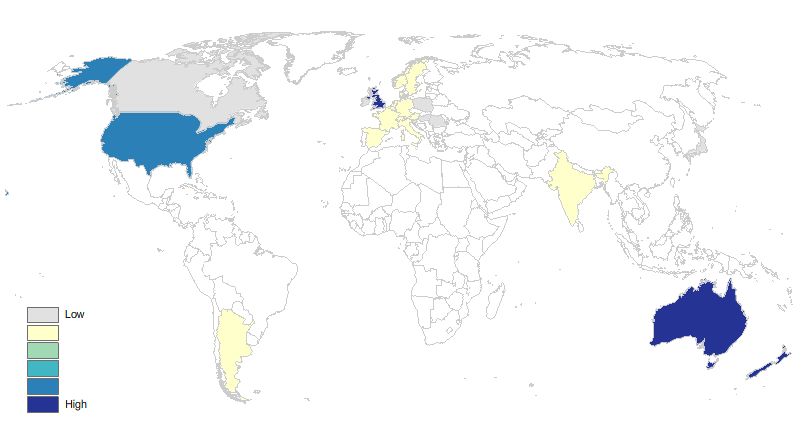
Frequency
of Ingram surname per Million of Population:
(
Enguerran,Engrand,Ingrand
) is a medieval French name, derived from aGermanic
nameEngilram( Engelram,Ingelram
), fromAngil, the tribal name of theAngles,
andhramn"raven". The Old
Frankish name is recorded in various forms during the 8th to 11th
centuries, the oldest attestation beingAngalramnus,
the name of abishop
of Metzof the 8th century; other forms includeAngilrammus,
Angelramnus, Ingalramnus, Ingilramnus, Ingelranmus, Engilramnus,
Engilhram, Engilram, Engelram, Hengelrannus(etc.)
TheOld
FrenchformEnguerran(d)is
recorded as borne by a number of high medieval noblemen ofPicardy.
The name was taken to England with theNorman
Conquest, and was adopted asIngramby
the late medieval period.
The
name was also conflated with a number of distinct, similar-sounding
Germanic names, such asIngerman, which has as
its first element the nameIngvar